From white box to soulful home
This month I wanted to go behind the scenes on a smaller project recently completed and share the design journey behind creating a vibrant home that suits our client perfectly. The project hasn’t yet been professionally photographed, so these images show moments from the design and build process.
When everything clicks
“Designing a home isn’t about colours and furniture, it’s much deeper than that. It’s about utilising space, thinking about flow, thinking about feelings and texture and the soul of a place too. Leo is so precise in her choices and solutions, and gives it so much thought, much like an artist.”
– Vinay, owner of a Dalston mews house and a recent client of Kinder.
A white box contrasted with a warm brief
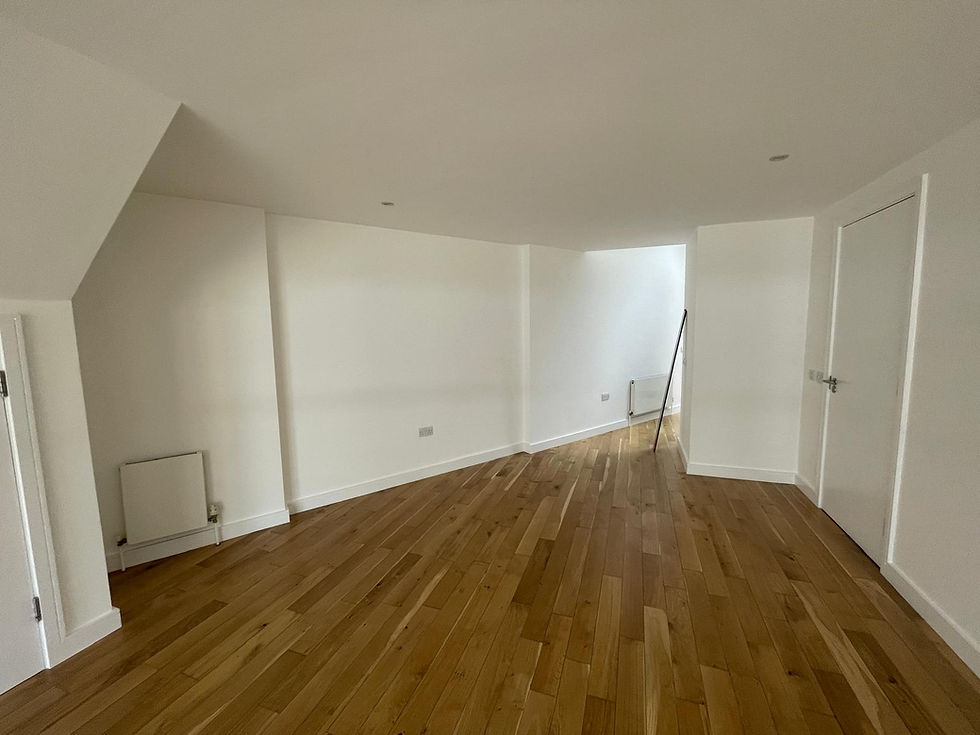
Vinay’s house sits in a private mews development tucked away in Dalston: a white box when he bought it, with a floor plan full of triangles and angles. That might sound awkward, but it was the project’s most interesting opportunity.
The brief was clear: a space where Vinay and his teenage son could cook together, eat, watch television and essentially, spend time together. He also wanted a dining area that could function as a workspace – somewhere he felt connected to the rest of the space rather than shut off from it.

The moment it all made sense
I describe the early stages of any design project to clients like circling slowly closer towards a bullseye. You’re gathering information, testing ideas. And then the moment comes when something clicks.
That happened when Vinay shared some pictures of kitchens he liked. I spotted something which sent me straight back into the recesses of my mind: the work of Francesca at Jetsam Made kitchens. I’d come across her (and her metal and plywood kitchens) previously, and remembered her unique designs.
I knew instantly it was right for Vinay. He liked ply and appreciated craftsmanship with personality, and working with an independent maker rather than a run-of-the-mill supplier aligned completely with the spirit of the project.
What followed was genuinely collaborative. Francesca suggested knocking down a dividing wall early on – something I hadn’t yet seen myself, but the moment she said it, it was obvious. That single move transformed the cramped, angular layout into a proper open-plan space: kitchen at the front, a dining and working zone in the middle, and what had been a dead corner became a reading nook.
The small space also meant it necessary to do an inventory of what Vinay actually needed from the space and, with Francesca’s input, the design included a slimline dishwasher, a spice rack squeezed into a spare ten centimetres and a wine rack wrapped around a corner.


Colour as a thread
The cabinets are in two colours: a chartreuse for the main run, and a green for the desk area and its corresponding legs. They’re bold choices, but not arbitrary ones.
The yellow picks up on the green without competing with it, making the desk feel like its own entity – a deliberate workspace, not just a surface. Those two colours do the heavy lifting, which is why the overhead cabinetry needed to be quieter: reeded glass panels to bring softness and stop the whole thing feeling too industrial. Knowing what to quieten down is just as important as knowing what to amplify. There are no plinths on the bases either – a small detail that keeps the design feeling light rather than boxy.
The idea for mauve floor tiles came from the sofa. I’d noticed its maroon upholstery and knew that was a thread worth pulling. A tile in a related tone grounds the kitchen as its own zone, and creates a material contrast with the ply that extending the wood floor simply wouldn’t have achieved. Changing the flooring also enabled us to add underfloor heating to the kitchen zone and free up wall space by removing a radiator.

The honest truth about sustainability
Plywood is a great material – it’s hardwearing, versatile, better than MDF or chipboard. But I’ll be honest: this kitchen is probably a seven out of ten on sustainability, not a nine. The metal frame is recyclable but plywood contains adhesive resins that can’t be properly broken down at end of life. And the worktop is quartz, which is not the most sustainable option on the market. However, the heart of this project was about doing something well: specifying thoughtfully, building for longevity and working with makers who care.
As Francesca puts it, "the kitchen was designed and made to last – it’s manufactured in the UK in a small workshop with a low carbon footprint. A kitchen that’s genuinely well made is far less likely to be ripped out in a decade than a generic, off-the-shelf alternative".

We deliberately didn’t design cabinets for the diagonal back wall of the kitchen as this was a new space for Vinay and we didn’t yet know how he’d use it. That final piece of joinery is being designed now by Jetsam Made, informed by how he’s been living in and using the kitchen.
Sometimes the right decision is to wait, and when the time is right, everything clicks into place.

The bench, the records, and why collaboration is the best bit
Separate from the kitchen, the dining bench – built by Jack at Worksmith, someone I’ve collaborated with for over a decade – is one of my favourite details. Vinay has a serious record collection, so the bench needed to incorporate two metres of vinyl storage, work around a radiator and be comfortable to sit on. Jack brought all of that to life from a sketch and a conversation.
This is the bit I love most. I’m not a joiner and I’m not a kitchen storage specialist, but I know the right people, and I know when to bring them in. Choosing collaborators who are brilliant at what they do, who care about the craft and bring their own thinking is what elevates a project. It also keeps an ecosystem of independent makers alive, which feels just as important as the design itself.

Join the Kinder Journal for thoughts on homes, design and the stories behind the projects.